Renishaw and Talgo promote additive manufacturing in critical components of the railway sector
The railway industry is at an inflection point where operational efficiency, Weight reduction and sustainability are dictating the innovation agenda of companies like Talgo, leading Spanish company in design, manufacturing and maintenance of high-speed trains and railway equipment. With headquarters in Vitoria-Gasteiz (Álava-Alava), It carries more than 80 years operating in the market.
Among its main lines of innovation, highlight the creation of hybrid trains with hydrogen and batteries to eliminate emissions on non-electrified lines; the design of high-speed trains with distributed traction to reduce energy consumption, and the improvement of the movable rolling system to facilitate interoperability between networks. Added to this is a decided commitment to weight reduction as a hallmark., driving the design of lighter structural components, the incorporation of advanced materials such as carbon fiber and the adoption of new production processes, like additive manufacturing.
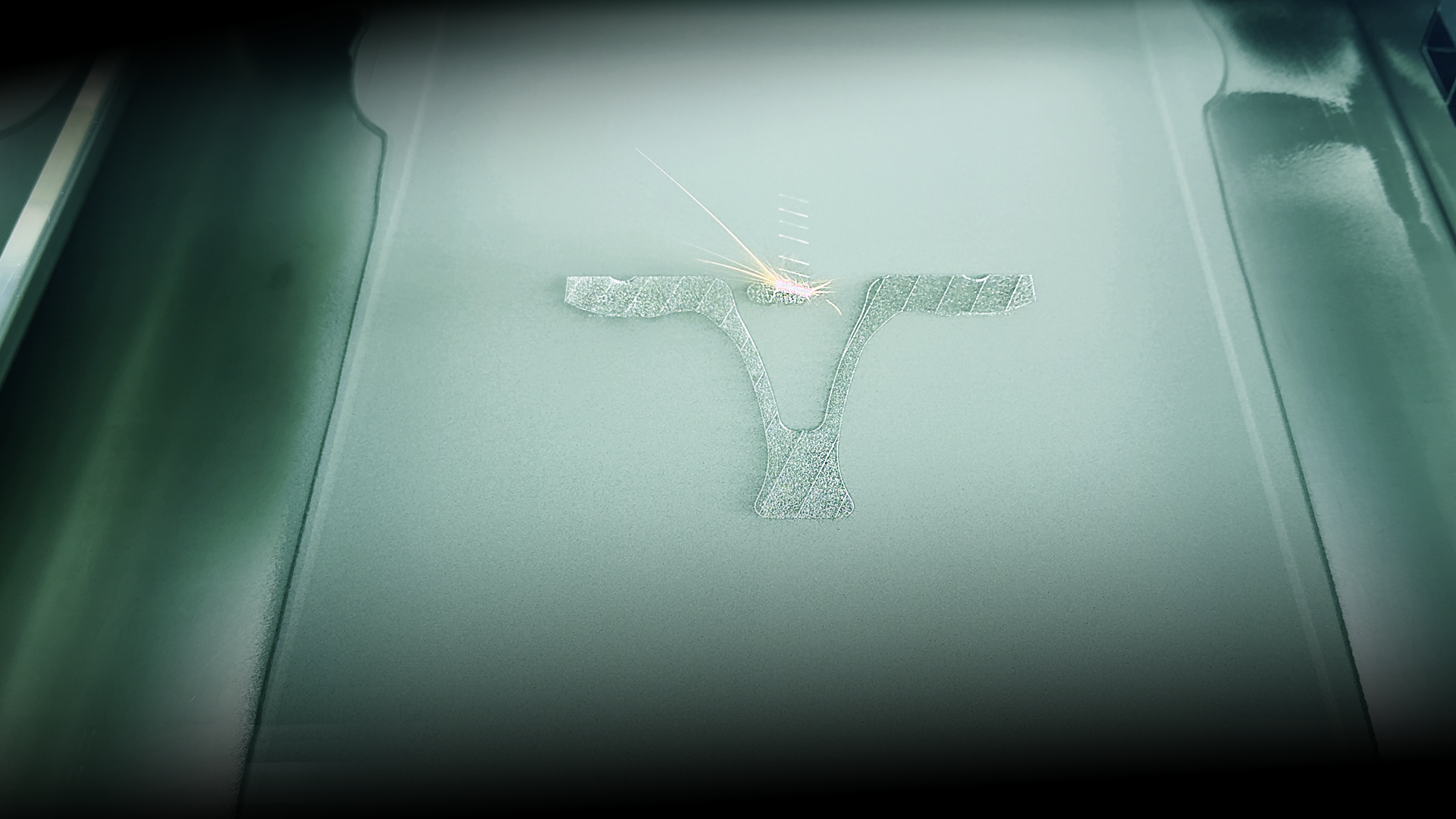
It is in this last area where the collaboration with Renishaw Ibérica is born, Spanish subsidiary of the Renishaw company, specialized in smart manufacturing systems, measurement and additive manufacturing. Through its Solutions Center model, Renishaw brings experience in adapting designs to metal 3D printing technologies using laser powder bed fusion (LPBF). “LPBF technology allows complex geometries and very tight tolerances to be manufactured, difficult or impossible to achieve with conventional methods. Besides, “It makes it possible to make modifications to the piece in a simple way.”, rates Alex Garcia, design and additive manufacturing applications engineer at Renishaw Ibérica.
with this project, Both companies have explored the potential of metal additive manufacturing in a highly structurally demanding part., laying the foundation for a new generation of railway components that combine safety with lightness, aligned with more efficient and sustainable global mobility. Besides, have studied the adaptation of the design to even lighter materials, like aluminum, opening the door to future evolutions that further reduce weight.
Aim: redesign the weight bar support
The project focuses on a high responsibility component: The transmission support of the vertical load transmission bars between train cars, an element subjected to loads of up to 11 tons. The original piece consisted of two metal sheets welded together, with limited functionality due to the difficulty of making individualized adaptations and due to the dependence on welding, which complicated its replacement and maintenance.
When exploring metal additive manufacturing for this component, The Talgo team proposed a double challenge: on the one hand, Optimize the design by integrating multiple parts into a single functional component that eliminates welding and simplifies assembly. On the other, make the supply chain more flexible by allowing customized parts on demand, always guaranteeing security identical to the original, but with superior lightness and durability.
The redesign of the component was jointly led by the Talgo and Renishaw engineering team.. According to Alex Garcia, “The main challenge was to correctly define the boundary conditions in the simulation software, “because the piece is subjected to tensile and compression loads applied in multiple orientations.”. For it, ANSYS software was used, performing a topological redesign with the purpose of optimizing the geometry, reduce weight and maintain the necessary structural strength.
for his part, the Biscayan company Addimen, specialized in the design and manufacture of metal and plastic parts with high added value using 3D printing technologies, was responsible for the production and post-processing of six units of the component, including support removal, polishing the rougher surfaces and machining the critical areas. For it, used Renishaw's RenAM 500S manufacturing system.
The result is a component that integrates three original pieces in a single geometry., capable of supporting the same loads as the conventional version. After undergoing demanding fatigue tests of 10.000.000 of cycles, the part has demonstrated the durability required for the railway environment. “We are not looking for a functional comparison against the existing solution, but to guarantee that the component maintains the same functionality with equivalent guarantees”, says Francisco José García, Talgo product innovation engineer.
Now the completion of the testing phase in different mooring configurations and repeatability of results is pending.. Once completed, Talgo will be able to introduce the component both in new series of trains and in existing series, prior approval of the corresponding railway authority.
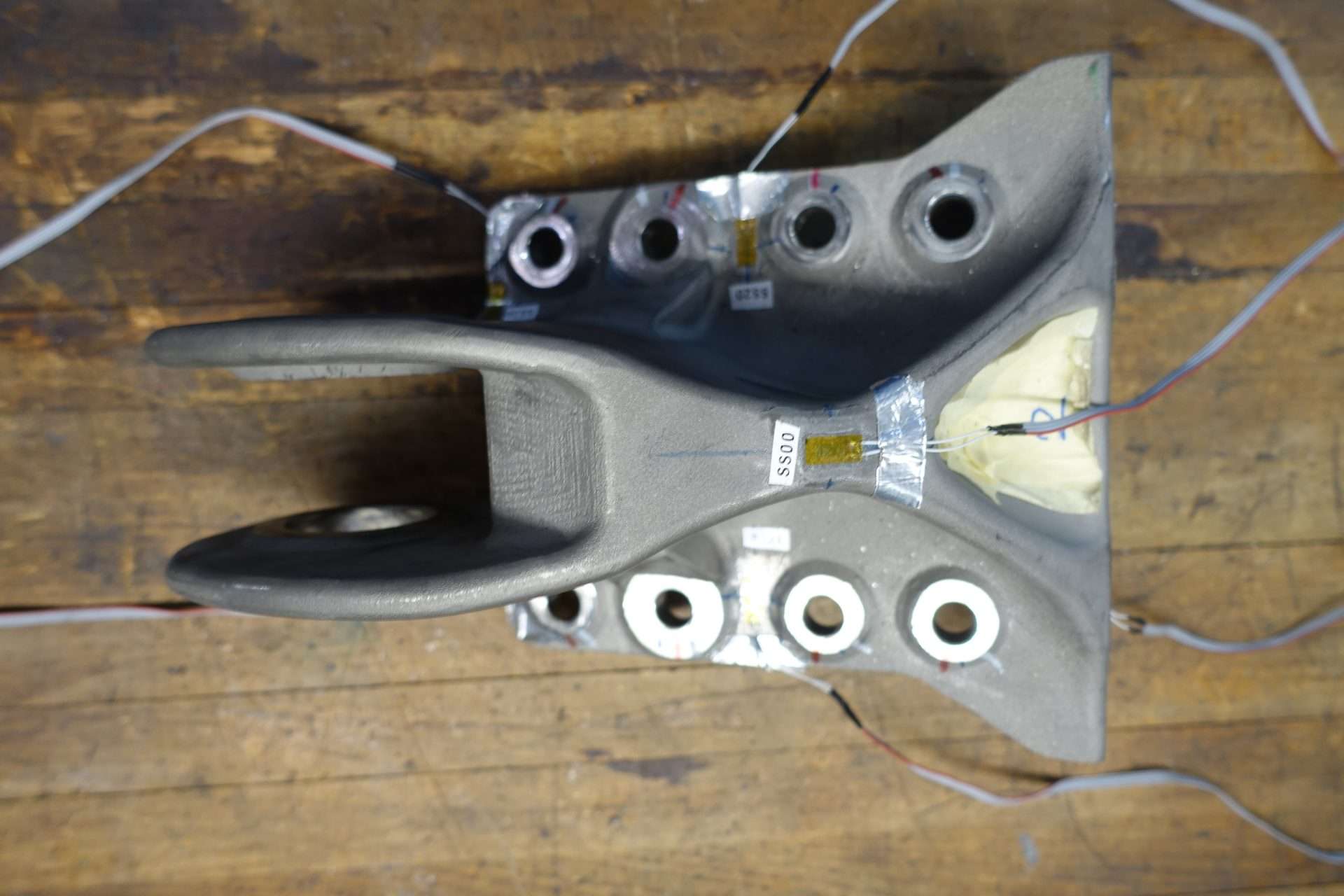
Dimensional verification with measurement in 5 axes
In addition to manufacturing the part, Renishaw has participated in its dimensional verification using the three-dimensional machine 5 ejes CMM AGILITY®. In a piece like this, with abundance of diameters, measurement in 5 axes allows you to verify all dimensions with a single probe, which speeds up programming and reduces time spent on calibrations. Besides, This technology makes it possible to access any area of the piece from practically any angle, even below the base, simplifying tooling design and reducing preparation times.
“The measurement in 5 axes is inherently faster than conventional 3 axes, and this advantage is especially relevant when measuring diameters. In this piece, The total measurement time can be reduced by up to 50% compared to a conventional CMM”, Marcos Digón values, applications engineer at Renishaw Ibérica. “By minimizing machine movements and keeping the probe optimally oriented, the technology of 5 axes improves the accuracy of the measurements and increases the reliability of the results”.
Thus, Renishaw has provided a complete ecosystem ranging from additive manufacturing to dimensional inspection, closing the production cycle with the same quality guarantees that the railway sector demands.
Additive manufacturing and metrology in the railway sector
This collaboration between Talgo and Renishaw illustrates how metal additive manufacturing and metrology can transform railway production and maintenance, accelerating development cycles through rapid prototyping and implementing highly customized design tweaks. On the other hand, by facilitating significant weight reduction in components and eliminating processes such as welding, Additive manufacturing aligns with energy efficiency and carbon emissions reduction goals: optimized energy consumption, simplified assembly and maintenance, less inventory of assembled parts and spare parts logistics also optimized.
“We are considering metal additive manufacturing for the production of other components, especially in supports of reduced dimensions that adjust to the capacity of current equipment. This technology is particularly valuable in both prototyping and replacing existing elements for unique applications.. Cases in which the reduction of supply times and the optimization of non-recurring costs make a fundamental competitive difference”, Francisco José García values, from Talgo.
Powering the trains of the future
The collaboration between Talgo and Renishaw Ibérica demonstrates that metal additive manufacturing and advanced metrology can work in an integrated manner in critical railway components, covering the entire cycle, from topological design to final dimensional verification. Beyond this project, The experience acquired opens the door to the expansion of these technologies within the sector, consolidating innovation, the efficiency and sustainability of the new generation of trains.