


Process control in the metalworking industry: how to reduce variability and optimize first pass performance
In the metalworking industry, Variability in production is a challenge for the competitiveness of many manufacturers, since it can generate non-compliant parts and lead to reprocessing that increases production costs and penalizes delivery times.. This, in an environment of increasingly tight margins and greater traceability requirements, becomes a clear disadvantage.
To reduce variability and optimize first pass performance (FPY), the key no longer lies in controlling the post-processing, but also the process itself (and in real time). Addressing variability at source allows adjustment of machining parameters, Automatically compensate for deviations and prevent errors before they materialize into defective components, positively affecting productivity, in the cost per piece and in the carbon footprint associated with each manufactured component, by reducing rejection rate and material waste.
The pyramid of the production process
The pyramid of the production process (Productive Process Pyramid™) It is a framework created by Renishaw, company specialized in smart manufacturing systems, measurement and additive manufacturing, to show how control levels can be used to systematically eliminate variation in machining processes. This pyramid is made up of four levels: the basis of the process, the preparation of the process, in-process control and post-process control.
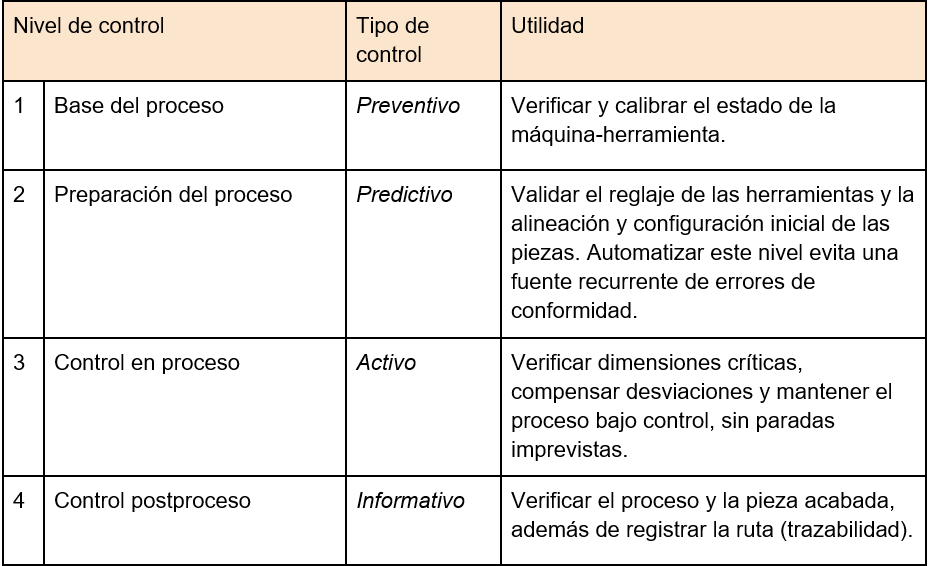
As the pyramid shows, The integration of measurement systems in the machine tool itself allows us to move from merely informative process control to active control. This approach allows you to manufacture correct parts from the first moment, reduce preparation times and significantly increase effective machining time.
Besides, process control automation not only improves efficiency, but facilitates unattended manufacturing and the extension of “lights out” production periods. At the same time, Automatic data collection guarantees complete traceability of the process (for example, to calculate the associated carbon footprint), a requirement increasingly demanded by clients and regulations.
In the current metalworking industry, process control can no longer be an isolated or reactive element. Integrating measurement and metrology into the heart of the production process allows manufacturing to be transformed into a more stable system., automated and predictable. The result is greater productivity, pieces with the required quality and a lower environmental impact, namely, greater competitiveness.


